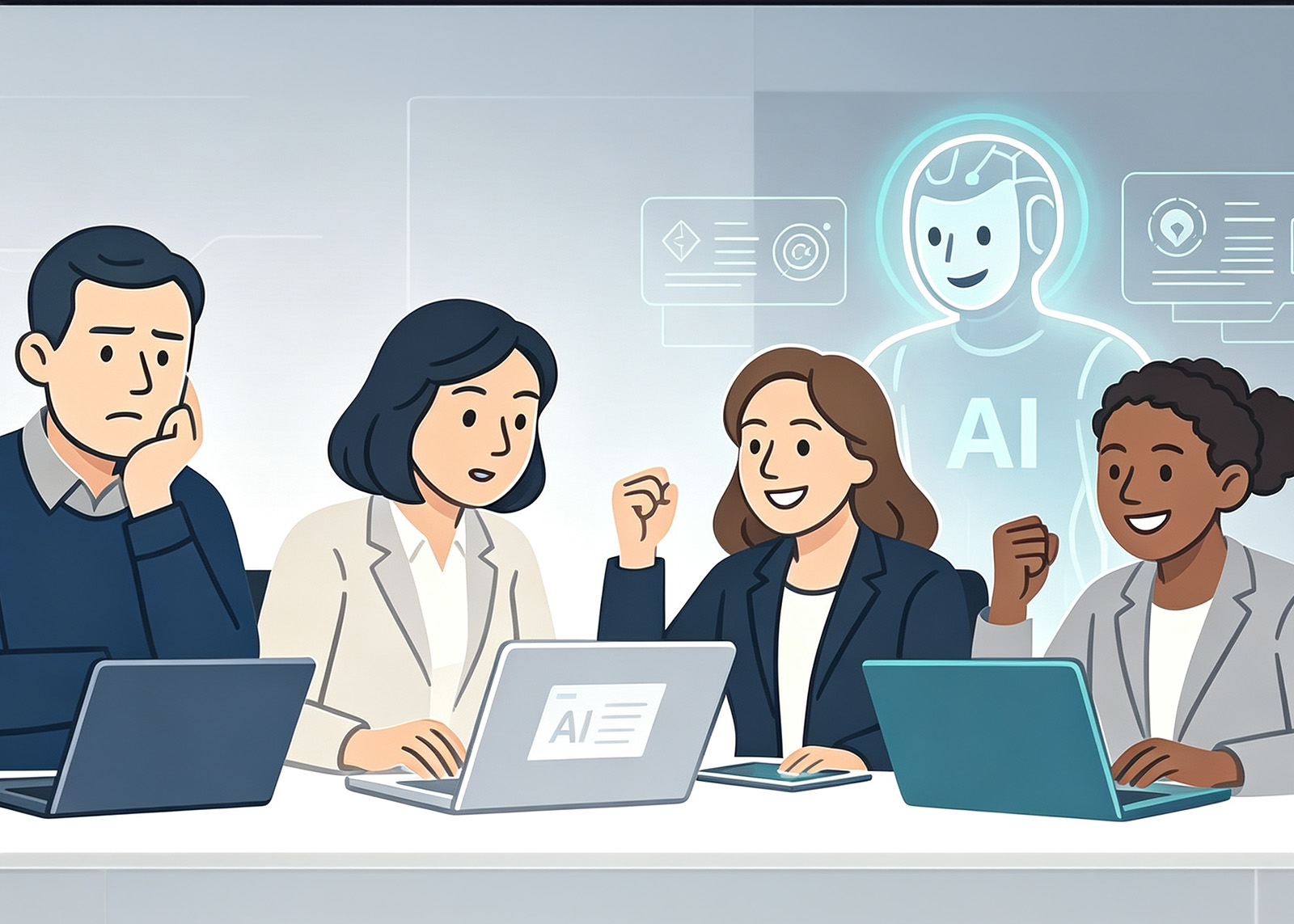
Since AI entered the design industry, the most visible shift has been speed. Market research can be pulled up instantly, interview recordings transcribe themselves, dozens of documents can be synthesized within hours, and copywriting, imagery, concept sketches and multilingual versions can all be produced far faster than before. Work that once took a team days now shows initial results within hours. For design firms, this is changing not just the pace of work, but cost structures and staffing as well. But even as speed increases, human judgment has not become less valuable — if anything, it has become scarcer.
Faster tools, however, do not automatically make a firm more capable. Most agencies today have access to similar models, software and generative platforms — the barrier to entry keeps falling, and workflows keep converging toward the same standards. Knowing how to use AI will soon be a basic skill, not a lasting differentiator. What actually matters is what happens once AI enters research, strategy and design: whether a firm can reorganize its work, decide which tasks belong to machines, and know which decisions still require a human hand.
This is the AI transformation taasdesign is pursuing. We are not measuring progress by how many tools we use, nor by how many extra images, drafts or proposal versions we can generate. Our goal is to embed AI into design thinking and project workflows in a way that resets the division of labor between people and machines — letting machines take on speed, scale and repetition, so strategists and designers can focus their taste, judgment, experience and human sensitivity where it matters most.
01 AI Is Changing the Division of Labor
No matter how capable a machine becomes, it still depends on human input. That input is far more than a prompt — it includes objectives, boundaries, preconditions, evaluation criteria and an understanding of real-world context. AI can generate large volumes of answers from existing material, but it cannot independently decide what problem a company should be solving right now, nor judge whether a given direction fits the organization’s risk tolerance, market culture or long-term interests. It can offer options, but it will never bear the consequences of a wrong choice on the client’s behalf.
Human creativity, sensitivity to external change, and empathy between people all come from lived experience and social relationships. AI can recognize patterns and mimic the corresponding language and form, but it has never actually stood inside a client’s organization, never felt market pressure, and cannot sense how a decision lands on employees, consumers and partners. It can describe these relationships, but it is not part of them.

This is why taasdesign is building human-machine collaboration, not AI supremacy — and certainly not simply cutting people out. AI’s value lies in reducing low-value, repetitive labor and expanding the scope of research and creative work, freeing people to spend more time observing, understanding, questioning, creating and deciding. The more machines can handle the groundwork, the more human expertise should concentrate on the moments that actually shape a project’s direction and outcome.
This also means that the more capable AI becomes, the higher the bar rises for people. Once generation becomes easy, the scarce skill is no longer producing more — it is judging what deserves to survive. Users need to ask precise questions, set effective constraints, catch factual errors and logical gaps, and hold a point of view of their own: knowing what is actually good, and what merely looks complete.
02 From Using Tools to Rebuilding the Workflow
In design and strategy work, many of the most important capabilities have long lived inside individual experience. A research lead knows which line in an interview is worth pushing on; a design director can tell that a concept is formally complete yet lacks real distinctiveness; a strategy director often senses that what a client says they need in a meeting is not the problem the organization actually has to solve. These judgment calls happen every day, yet they are rarely broken down in full.
Once AI enters the workflow, we are forced to explain our own work more precisely: why one phase needs to keep diverging while another should stop exploring; which actions are simply data processing and which already involve defining the problem; which tasks can be batch-completed by rule, and which decisions must draw on industry experience, cultural context and organizational reality. This process is not just a technology rollout — it is a re-examination of what design consulting actually is.
For taasdesign, this has been a process of self-distillation. We have taken apart a decade of accumulated project experience, piece by piece, to identify which steps genuinely create value and which are simply habits carried forward out of routine. Some of the work people used to do was always suited to automation — the right technology just wasn’t available yet. Other work looks simple on the surface but carries substantial tacit aesthetic judgment, business judgment and understanding of people that cannot easily be handed to a machine.
This kind of unpacking is also an act of reflection and refinement. It forces us to reconsider where our expertise actually resides, and gives the team a chance to turn experience that once lived only in individuals into methods that can be explained, taught and reused. Becoming AI-native, then, is not just about efficiency — it is pushing the firm to convert tacit knowledge into organizational capability.
03 Bringing AI into Design Thinking, Not Just the Toolkit
Divergence and convergence in design thinking give this work a clear observational framework. The Double Diamond model sits at the methodological core of what we do — its value lies in helping us identify where an innovation process needs to widen the range of possibilities, and where it must instead commit to a judgment. AI is particularly good at divergence: in a short time it can scan more material, generate more hypotheses, and lay out more visual directions and copy variations. Possibilities once constrained by time and headcount can now surface much earlier.
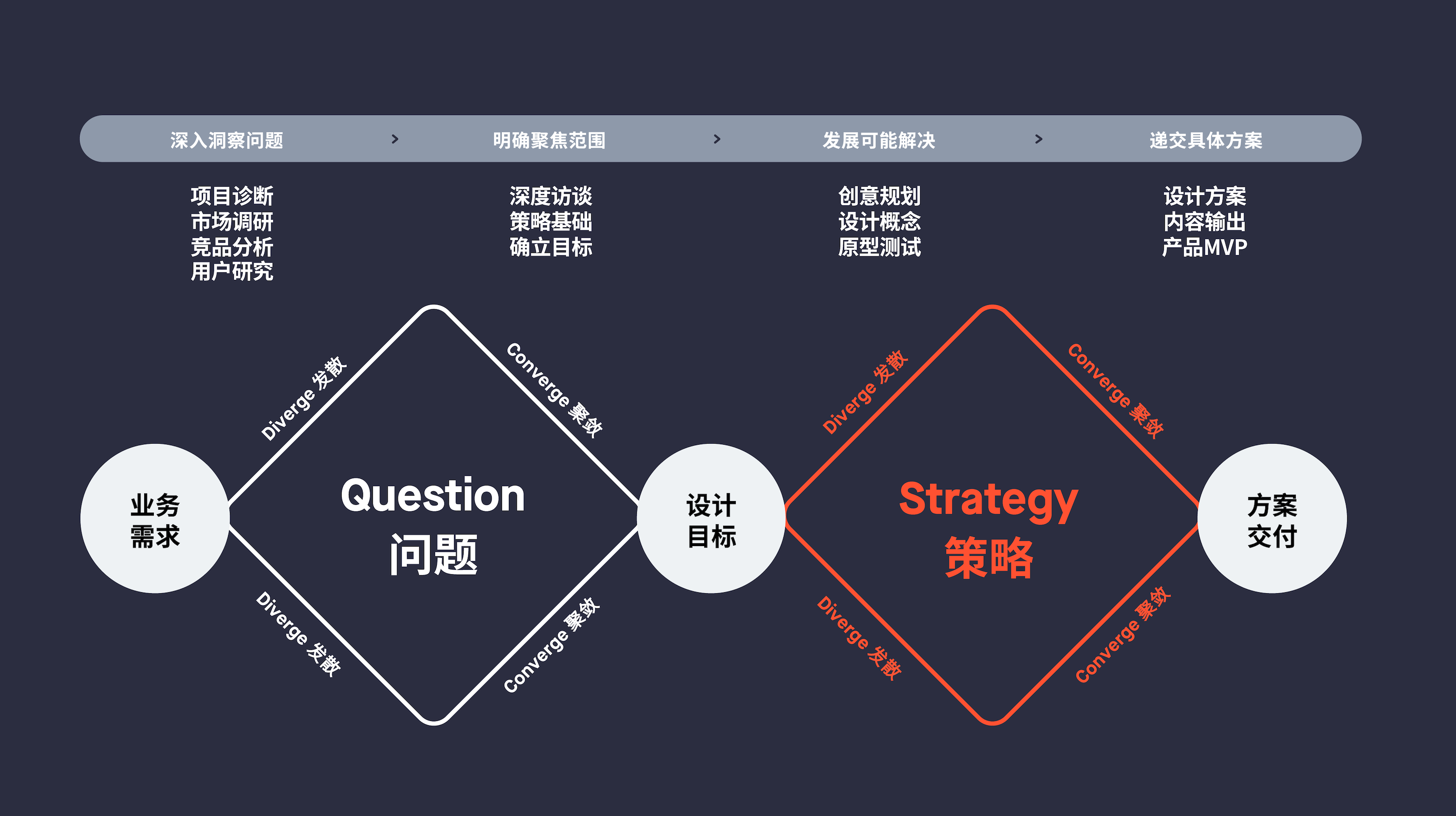
Once the cost of divergence drops, the bottleneck in the work shifts. The old problem was that a team couldn’t come up with enough directions; the new problem is that, faced with a large number of directions, it can’t tell which ones actually matter. More options do not automatically produce better answers. Without clear human judgment criteria, a team is easily led along by output that merely looks finished, eventually settling for a barely-adequate option out of dozens of similar ones.
In early-stage research, AI can quickly organize interviews, scan competitors and market information, and categorize unstructured material, helping the team spot recurring themes. The consultant’s job is to judge what those signals actually mean. A problem clients keep raising may just be the surface symptom of something the organization has carried for years; an inconspicuous thread in one interview may reveal the real contradiction. That kind of judgment cannot be produced from word frequency, data density or a model-generated summary alone.
Moving into the strategy stage, AI can organize scattered information into structure, compare consistency across sources, and help the team form multiple problem hypotheses. What’s genuinely difficult is judging which problem is the root cause, and where the organization should commit its resources right now. A direction that is theoretically correct may not fit the organization’s current capacity or timing. Strategists have to weigh commercial objectives, budget constraints, internal resistance, governance structures and long-term value all at once before making the trade-off.
The same holds in design development. AI can quickly generate visual concepts, copy directions, multilingual versions and expressions in different styles, letting designers see more possibilities earlier. But the more options there are, the more aesthetic judgment matters. Once anyone can generate dozens of seemingly mature visuals in a short time, the value of design work no longer comes from volume — it comes from the ability to tell the difference. Which direction is simply copying a style that already exists in the market, and which can build a durable brand asset; which concept satisfies the client’s stated brief but fails to answer the real problem — these calls still depend on a project team’s experience, perspective and cultural sensitivity.
By the delivery stage, machines are well suited to checking numbers, terminology, formatting and consistency across pages, and to reducing human error in repetitive work. Once a project meets the real world, budget, time, technical constraints and internal client opinions tend to collide all at once. What must be held firm, what can be phased in, and which seemingly small adjustment would break the whole system — these still require strategists, designers and clients to work out together.
04 Every Project Becomes Accumulated Capability
Every project we complete leaves behind new experience: which research methods improve the quality of material, which information structures help surface root causes, which conditions shape strategic choices, which human-machine handoffs improve efficiency, which checks reduce delivery risk. Once organized, this experience feeds back into the next round of research, strategy and design, and gets tested again on the next project.
This creates a mechanism of continuous accumulation. The more projects we complete, the deeper taasdesign’s understanding of an industry, a market and an organization becomes, and the clearer the boundary between human and machine work grows. AI’s role in this is not to replace experience — it helps the firm organize and test experience faster, and turn part of what once lived in individuals into methods the whole team can share.
This accumulation ultimately flows back into client value. Early-stage research can cover more ground while still holding on to an understanding of specific context; the strategy stage can compare and validate hypotheses faster, keeping consultants’ time focused on the questions that actually drive decisions; the design stage can open up more possibilities and then filter them against clear brand standards; and the delivery stage sees fewer mechanical errors, freeing the team to put more energy into the trade-offs and communication that implementation demands.
The value AI brings, then, is not simply doing the old work faster. The more important shift is that the quality of human judgment improves — a theme closely tied to the organizational capability question we explored in Human-AI Collaboration: Why 66% of Saved Time Goes to Waste, two facets of the same underlying issue.
05 Human-Machine Collaboration Is Not the Cautious Choice
The international innovation consulting industry has already begun openly debating whether traditional innovation processes can still keep pace with the AI era. Around 2024, Board of Innovation began arguing that the classic Double Diamond model was becoming outdated, and introduced its AI-driven Stingray model. As a firm that has worked with the likes of Walmart, Coca-Cola and Nestlé, this wasn’t an outsider’s observation — it was a direct challenge to how the industry works, coming from inside it.
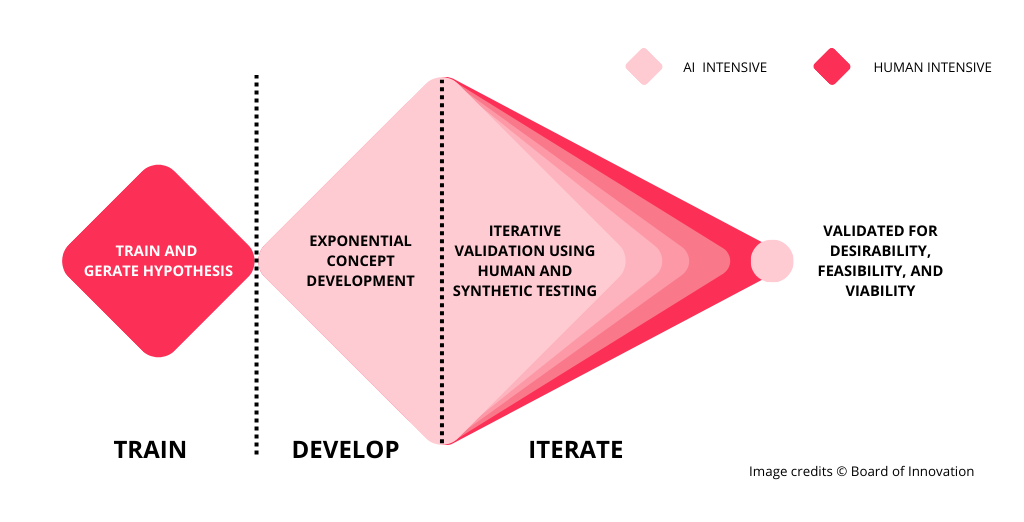
The Stingray model argues that AI can explore more problems and solutions in parallel, and bring technical feasibility and commercial conditions into the innovation process earlier. That claim has real grounding, and taasdesign’s own AI transformation is likewise not about preserving old habits. Traditional processes genuinely contain a great deal of inefficiency, repetition and over-reliance on manual labor — and those parts deserve to be redesigned.
What’s telling is that even when Board of Innovation describes Stingray’s final iteration stage, it still leaves room for people. Humans are still needed to shortlist options, run real-world experiments and bring in expert judgment. The further you try to extend AI’s role in the innovation process, the more you run into the same boundary. Machines can widen the search, speed things up and assist with evaluation, but the final choice, validation and accountability still land on people.
This shows that the real question is not whether the Double Diamond is outdated, or which new flowchart should replace it. What matters is whether a firm truly understands how its work creates value, and whether it can put machines where machines belong and human judgment where it is needed most.
06 AI Is Widening the Gap Between People
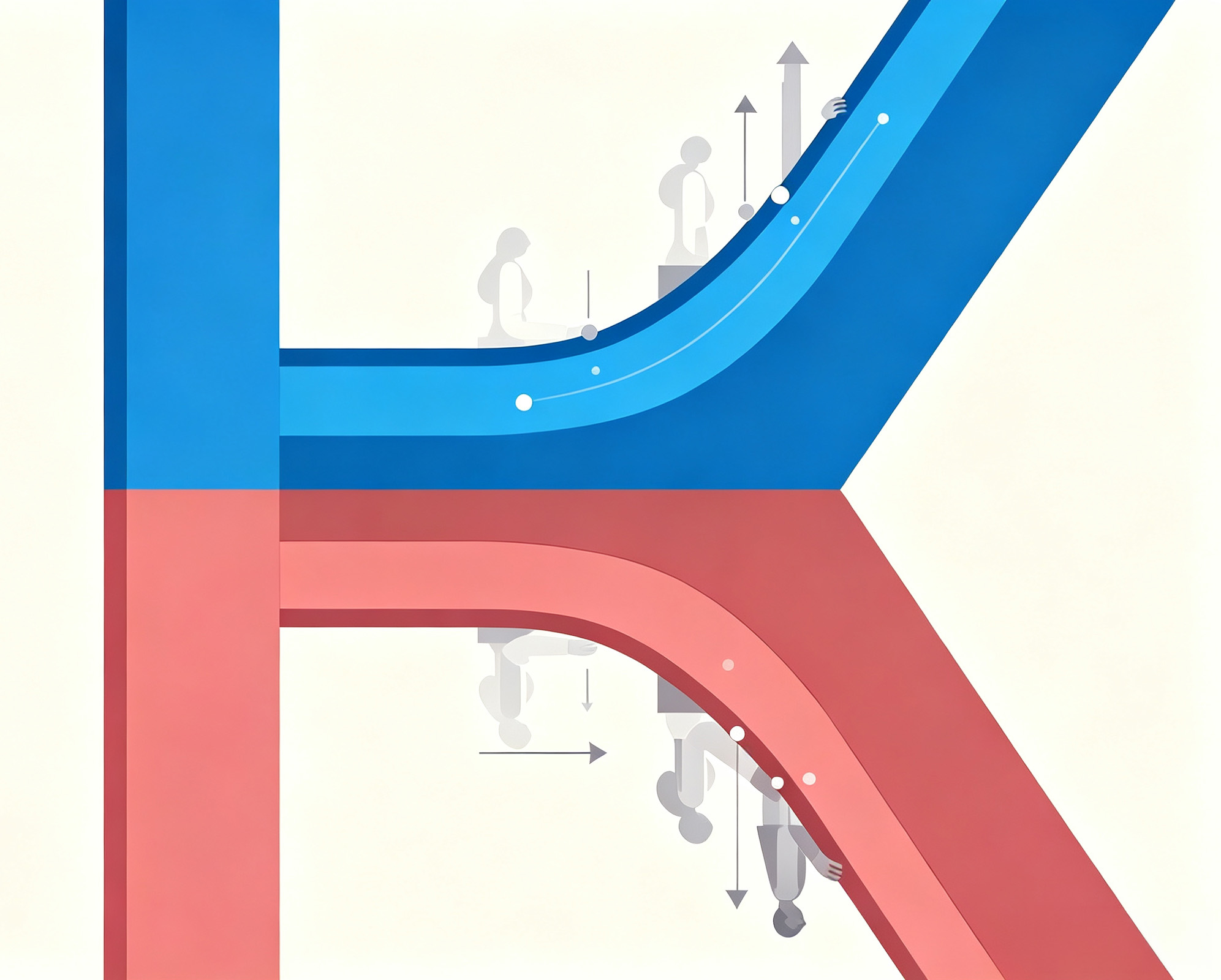
AI is accelerating a K-shaped divergence between individuals and organizations. On one side, people use AI to take on more complex problems, redirecting their time toward observation, thinking, creation and decision-making — and their expertise compounds as a result. On the other side, people treat generated output as the answer itself, skipping understanding, verification and human judgment; it may look like a short-term efficiency gain, but over time it can erode their own expertise.
A machine is an amplifier. It amplifies human capability, and it amplifies human mediocrity in equal measure. People without human judgment are easily persuaded by an answer that merely reads smoothly; people with real standards are the ones who can spot the errors, the emptiness and the sameness in an answer, and turn what a machine produces into something genuinely valuable.
This is why the AI era does not lower the bar for people — if anything, it raises it. The more powerful the tools, the more clear-eyed the judgment required; the faster the generation, the more defined the point of view required; the more options on the table, the more mature the taste required. People need to know what’s worth doing and what isn’t, and be able to explain why.
This is the core difference we want to build between taasdesign and other agencies. Our AI capability isn’t measured by how many tools we’ve bought, or how much content we can generate — it comes down to whether we can genuinely fold AI into design thinking, strategic judgment and project execution, continually taking apart what our work is really for, and reorganizing the relationship between people and machines.
Machines expand what’s possible. People decide the direction. AI offers more options; people judge which of those options deserve to become real.
In 1995, in an interview with Robert X. Cringely, Steve Jobs said something that has stayed with people ever since.
“Ultimately, it comes down to taste.”
In the end, it comes down to taste.
The taste he was talking about was never just about how something looks. It comes from prolonged exposure to the best things humans have made, and from an understanding of culture, business, technology and people. Taste is what lets us pick out the direction that actually matters from a pile of options, see what’s still missing from an answer a tool hands you, and determine whether what a firm ultimately produces is merely average and correct — or work with a point of view, a difference, and lasting value.
In the AI era, generation keeps getting easier.
Taste is the last gate — and the most important one.
Lorem ipsum dolor sit amet, consectetur adipiscing elit. Ut elit tellus, luctus nec ullamcorper mattis, pulvinar dapibus leo.