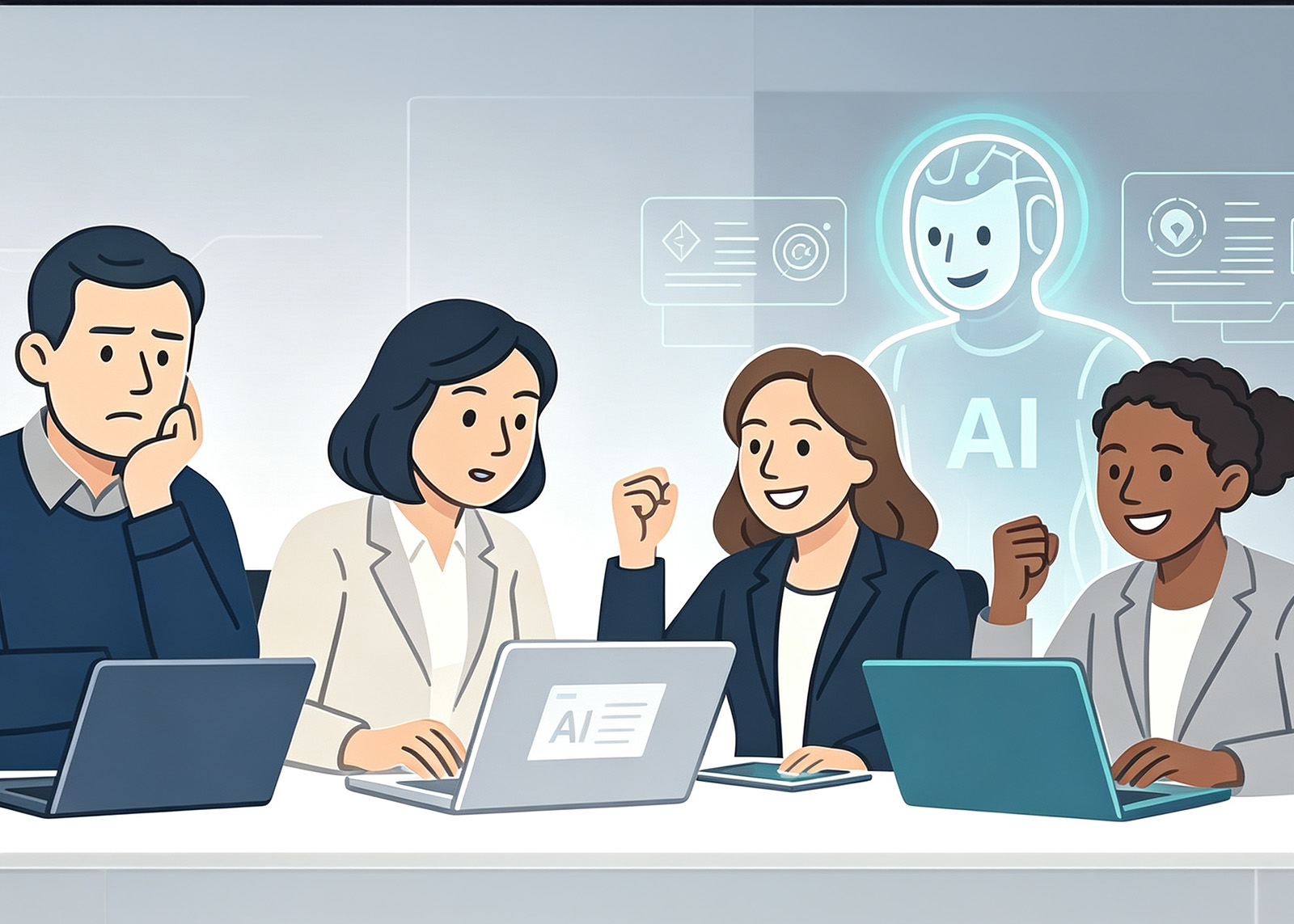
In “The Smarter the AI, the More Valuable Human Judgment Becomes,” we looked at how professional value shifts as AI becomes more widespread. As the cost of organizing information, generating content, and handling routine execution falls sharply, judgment, experience, taste, and the ability to read real situations and other people become scarcer, not more common. This piece turns to what human-AI collaboration looks like once that shift reaches the company as a whole, not just the individual.
The same shift plays out very differently at the company level. An employee who saves two hours with AI does not mean the organization gains two hours of productivity. Reports get written faster, but decision processes can stay just as slow. Marketing output goes up, but the brand doesn’t necessarily understand its customers any better. Tasks move faster inside a department, while waiting, re-confirmation, and finger-pointing between departments remain untouched.
BCG’s recent AI at Work report (2026) surveyed nearly 12,000 employees, managers, and executives across 14 countries and found that among frontline employees who use AI regularly, 42 percent save at least eight hours a week, roughly a full workday. Yet 66 percent received no clear guidance on what to do with that time, and more than half never redirected it toward higher-value work. AI is changing how work gets done faster than companies are redesigning work itself. Closing that gap is exactly what deliberate human-AI collaboration is meant to do.
On the surface, the value gap companies now face looks like a process problem, tools moving ahead of workflow. At its root, it’s something else. AI transformation is still being treated as a technology rollout. Management focuses on what the model can do, which tasks can be automated, which departments can deploy an agent, without first answering a more basic question: whose work is the company trying to improve, what real problem is it solving, and what customer value and organizational capability is it actually trying to build?
Getting this right requires returning to human-centered design. Human-centered design puts people’s needs, behavior, experience, and actual circumstances at the center of problem-solving. It doesn’t reject technology, and it doesn’t mean holding back automation just to protect jobs. It requires companies to first understand how people work, how they exercise judgment, and what constraints they operate under, before deciding where technology belongs. People define the questions, set the goals, determine what counts as value, and carry the responsibility. Technology performs within those boundaries.
Design thinking is the method for putting human-centered design into practice. It helps companies enter real situations, understand the people affected by change, redefine which problems are worth solving, and refine solutions through co-creation, prototyping, and testing. Human-AI collaboration is the organizational capability this approach requires once it enters the AI era. Human-centered thinking sets the direction, design thinking provides the path, and human-AI collaboration recombines human judgment with machine capability.
01 AI investment fails when companies start with the technology
The easiest move for a company rolling out AI is to buy tools, open accounts, build a knowledge base, and then ask each department to propose use cases. Marketing, customer service, admin, finance, procurement, and HR can quickly produce a wish list, and management can point to user counts, output volume, and pilot projects as proof that transformation is underway.
The problem is that this approach starts from what the technology can supply, not from what the business actually needs. Companies see what AI can do first, then look backward for tasks to apply it to. The result is usually more applications with limited real effect on customers, revenue, decision quality, or organizational capability.
BCG’s 2025 research sorted companies into three groups. About 5 percent have built the capability to generate sustained value from AI. Another 35 percent have started scaling applications and are seeing partial returns. The remaining 60 percent have invested heavily with almost no measurable gain in revenue or cost. Leading companies generate roughly five times the revenue growth and three times the cost reduction of the rest. The gap isn’t only about models or spending. It comes from whether a company can actually redesign its business, decisions, and organization.
Interviews with AI practitioners published by Entrepreneur point to a similar failure pattern. Leaders hand AI to employees and let them figure it out on their own. Departments run scattered, unfocused experiments. Projects chase cost cutting over understanding people. Data goes into systems before it’s cleaned up. Companies rush agents into production to keep up with the trend. Heavy reliance on AI-generated content quietly erodes the brand’s original voice. On the surface these look like seven separate problems. Underneath, they share the same root, a company that never defined which problem was worth solving, and never worked out from real operations where AI actually belonged.
Customer churn might trace back to slow service response, or it might be declining product competitiveness. Weak marketing efficiency looks like a content shortage on the surface, but the real issue may be an unclear brand position that the team never agreed on internally. A long approval cycle sometimes comes from slow paperwork, but more often it comes from unclear ownership, too many decision layers, or managers unwilling to take on risk.
AI is good at handling tasks that have already been clearly defined. It doesn’t judge whether the question a company is asking is the right one. When problem definition stays superficial, stronger technology just lets an organization execute the wrong problem more efficiently. Companies end up with plenty of tools and use cases, but no capability that actually moves business outcomes.
02 Human-centered design isn’t about making people adapt to the technology
Human-centered thinking asks companies to start from a different place. Technology isn’t the starting point of transformation, the real needs of people and the business are. Companies need to first understand how the people affected by change actually work, what worries them, and which capabilities shouldn’t be eroded by automation, before deciding what AI should take on. That sequencing is what makes human-AI collaboration workable rather than imposed from the top down.
“People” here means more than consumers or end users of a system. It includes frontline employees, managers, customers, and partners, everyone touched by a new way of working. Different roles face different goals, information, risks, and responsibilities, so human-AI collaboration can’t be designed off a single standard template.
03 Design thinking helps companies find where AI actually belongs
The process management sees on paper describes how work is supposed to happen. What employees live through every day is how work actually happens. The two often diverge sharply.
An employee maintaining a personal spreadsheet outside the company system isn’t necessarily resisting it, the official system may simply not meet what the job actually requires. A task that needs sign-off from multiple managers isn’t necessarily a sign of weak execution, it may reflect the fact that the organization never established a clear standard for the decision. Customers who keep requesting changes aren’t necessarily indecisive, the project may never have identified the real decision-maker, user, and stakeholders at the outset.
These details rarely surface fully in leadership meetings, system data, or department briefings, yet they determine whether an AI application actually works. A company that skips real observation and deploys technology straight onto an existing process flow risks making an already broken process run faster, and risks eliminating the workarounds employees built to compensate for that broken process, mistaking adaptation for inefficiency.
Design thinking’s value is in pulling companies out of an abstract feature list and into people’s actual work. Through observation, interviews, and joint analysis, companies can see how employees really complete tasks, how customers experience service, where information breaks down, why decisions sit unresolved for so long, and what function an apparently inefficient habit is quietly serving.
This kind of understanding isn’t simply collecting employee opinions. People often can’t articulate what they actually need, and existing organizational behavior isn’t necessarily best practice either. Design thinking asks companies to look for clues in what people say, what they actually do, and the gap between the two, and to redefine the real problem from there rather than from surface symptoms.
Weak customer service may not call for a faster AI chatbot. It may point to unclear authorization or cross-department accountability. A shortage of marketing content may not need more content. It may point to an unclear brand position that the team has never aligned on. A long approval cycle may not be about slow document handling. It may point to decision standards that were never set. AI moves quickly on well-defined problems. It won’t catch a company that defined the problem wrong in the first place.
Design thinking, then, isn’t a user-experience polish applied after an AI project wraps up. It belongs at the very front of transformation. Companies need to understand people and the problem first, then decide whether AI is even the right answer, and how it should enter the work. That sequence looks slower than simply buying a tool, but it avoids automating, at higher cost, a way of working that was flawed to begin with.
04 Human-AI collaboration doesn’t happen on its own, it has to be designed
Managers often assume that handing employees an AI tool is enough, that people will naturally find a more efficient way to work. The reality tends to run the other way. When AI drops into an existing process, it can simply add a new step on top of the old one. Employees still have to complete the original task, and now also write prompts, check outputs, fix errors, and carry new responsibility.
Deloitte’s 2026 global human capital trends research found that nearly 60 percent of employees are already using AI deliberately in their work, yet most companies still design human tasks and technical systems separately, without designing how the two interact, collaborate, and share decisions. Fifty-nine percent of organizations take a technology-first approach to AI, and only 14 percent of leaders believe their organization is good at designing human-machine interaction. Sixty-six percent of leaders acknowledge this capability matters greatly to success, yet only 6 percent of organizations are actually ahead on it.
Effective human-AI collaboration doesn’t emerge automatically once AI is deployed. It has to be designed deliberately. Companies need to re-examine the full path a piece of work travels, from when the need arises to when the result is delivered, tracking how information flows, who holds decision rights, which outputs require review, who is accountable when something goes wrong, and how the handoff between person and machine actually works.
Handling a customer complaint can involve receiving the information, classifying the issue, pulling records, assessing responsibility, obtaining internal authorization, forming a resolution, and communicating with the customer. AI can compress record retrieval and initial classification down to seconds. But if the authorization structure hasn’t changed and accountability is still unclear, the customer still waits. A faster individual task doesn’t mean the end-to-end customer experience has actually improved.
Machines are well suited to processing large volumes of data, spotting patterns, producing first drafts, and running checks against clear rules. People are needed to read context, spot exceptions, sense what a customer hasn’t said out loud, make commercial trade-offs when information is incomplete, and manage relationships among different stakeholders. Much of the work belongs to neither side alone. People need to set the goal, the boundaries, and the evaluation standard, let AI widen the scope of exploration and execution, and have a qualified, accountable person complete the final verification and decision.
Deloitte’s research shows that companies actively redesigning human-machine interaction, roles, and workflows are twice as likely to meet or exceed their AI investment returns. A European telecom company initially bolted an AI “expert” onto its existing customer service process and saw productivity rise just 5 percent. It later redirected most of its full-deployment budget toward redesigning workflows, trust boundaries, escalation paths, and employee capability, and productivity rose 30 percent. The data point to the same conclusion, AI value comes primarily from redesigning the work, not from stacking a stronger tool on top of an unchanged process.
The goal of human-AI collaboration also isn’t maximizing the automation rate. The real question is which parts of a job need speed and which need judgment, which parts can be standardized and which require reading specific context, what can be handed to a system and what responsibility has to stay with a person. Companies need to find the combination that amplifies both business results and human capability, not simply count how many manual steps got replaced.
05 Employee resistance is often a rational response to broken organizational rules
When AI adoption stalls, management often attributes it to employees being conservative, reluctant to learn, or afraid of being replaced. The reality is more complicated than “acceptance” versus “resistance.” Some employees avoid the company’s AI tools entirely. Some use them but won’t admit it to their managers. Others quietly switch to tools they consider more effective than what the company provides. None of this necessarily means employees oppose AI itself. More often, it’s a response to rules and incentives the organization hasn’t yet worked out.
Slack surveyed more than 17,000 knowledge workers globally and found that 48 percent feel uncomfortable telling their manager they used AI to complete certain work. Among them, 47 percent worry it will be seen as cheating, 46 percent worry it will be read as a lack of competence, and another 46 percent worry it will look like laziness. Notably, fear of a company policy banning AI use ranked lowest among the reasons for staying quiet. The main barrier to employee behavior isn’t tool access. It’s the absence of clear, credible internal norms for how AI should be used.
A task that once took five days might now be finished by an employee in one, with AI’s help. If the company still evaluates work by hours logged, task volume, or visible busyness, employees have little incentive to disclose the efficiency gain. Finishing early often just means being handed more work, not better evaluation, more authority, or fair reward. Under those rules, hiding AI use and hiding saved time isn’t just an attitude problem. It’s a predictable, rational response to an outdated management system.
Deloitte calls this AI’s “cultural debt.” Forty-two percent of employees say their company rarely assesses AI’s actual impact on people. Eighty percent of leaders, managers, and employees worry that colleagues or teams are using AI to appear more productive than they really are. When an organization never answers whether using AI counts as cheating, what actually counts as effort, who’s accountable when AI gets something wrong, and whether refusing to use AI puts a job at risk, employees end up quietly writing their own rules, and trust erodes along the way.
Human-centered human-AI collaboration has to deal with these realities directly. Employees shouldn’t be told how to use a system only after it’s already live. They need to take part in identifying problems, breaking down workflows, testing prototypes, and evaluating results, because frontline staff understand the exceptions, the risks, and the tacit knowledge in the work better than anyone. Involvement isn’t just about how employees feel about the process. It sharpens problem definition and solution design, and it shifts employees from passively receiving technology to actively co-designing the future way of working.
Companies also need to redesign performance evaluation, workload expectations, recognition, and career growth in parallel, so that individuals and the organization actually share in the efficiency gains AI produces. When employees improve a process and share what they’ve learned, they should get access to more valuable work, more room to grow, and fair reward, not simply more tasks. Only when people believe that being transparent about efficiency won’t work against their own interests does the hidden productivity AI creates have a chance of entering the organization’s system.
06 AI’s ultimate value depends on whether it amplifies human capability
Cost reduction and time savings are the easiest parts of AI’s value to measure, and the easiest for competitors to copy. Rivals can buy the same models and adopt similar automation methods. Once an entire industry lowers the cost of content production, information handling, and customer response, those advantages quickly become table stakes. What’s genuinely hard to copy is a company’s ability to use AI to build a faster, more accurate learning loop. Manufacturers can shorten the distance between customer feedback and product improvement. Retailers can sense shifts in demand across markets earlier. Professional services firms can turn senior expertise into organizational knowledge. Brands can translate shifting consumer sentiment into product, service, and communication decisions faster.
People remain at the center of all of this. AI expands how much information can be processed, people decide which shifts are worth responding to. AI shortens analysis time, people decide what action the company should take. AI makes knowledge easier to retrieve and recombine, people apply experience back into specific situations. The competitive advantage AI creates doesn’t come from people stepping back from work. It comes from an organization concentrating human insight, creativity, empathy, judgment, and accountability where they matter most.
BCG’s research found that only about 5 percent of companies can scale AI value, while nearly 60 percent see almost no impact at all. Many companies, once they notice the gap, respond by adding more tools, without building the human capability needed to turn adoption into business outcomes. Effective capability-building can’t stop at introducing AI concepts and teaching prompt techniques. It has to help employees apply that knowledge to real work, and embed the new behavior into roles, processes, support systems, and incentives.
The World Economic Forum’s survey of more than 1,000 global employers found that 63 percent see the skills gap as the biggest obstacle to future transformation, and 85 percent plan to prioritize upskilling. AI and big data are the fastest-growing skill categories, but analytical thinking, creativity, resilience, flexibility, leadership, and social influence remain the core capabilities companies value most.
What companies need going forward are people who can combine technical fluency with business judgment, creativity, collaboration, and leadership. The goal of building organizational talent capability isn’t getting every employee onto the same tools. It’s helping different roles understand how AI will change their own work, which tasks can go to a machine, which capabilities need to be strengthened, and what responsibility they’ll carry in creating value going forward.
07 AI transformation is first a management responsibility
It’s easy for a company to treat AI as an IT department project, or to let employees explore it on their own in daily work. That approach looks like it spreads the risk. In practice, it also spreads out direction and accountability. Without management making clear decisions on business problems, value targets, and organizational rules, AI adoption stays limited to scattered experiments and individual efficiency gains.
BCG’s AI Radar 2026 found that 72 percent of CEOs are now the primary decision-maker on AI at their company, double the year before. Companies expect AI investment to rise from about 0.8 percent of revenue to 1.7 percent in 2026, nearly doubling, and more than 90 percent plan to maintain or increase investment even without a near-term return. AI is no longer a single issue owned by IT or innovation. It’s an enterprise-level transformation touching strategy, operations, talent, culture, risk, and governance simultaneously.
Leaders don’t need to become model experts, but they do need to understand what AI can and can’t do, choose which business problems are worth the investment, decide which responsibilities can’t be handed to a machine, and figure out what new purpose the time and capacity AI frees up should serve. Management also needs to adjust performance metrics and resource allocation, set clear rules for AI use, give employees a safe space to experiment, and measure progress by customer value, decision quality, and business outcomes, not account activations or prompt counts.
When a company pushes employees to use AI while keeping the same workload expectations, approval process, and performance standards, employees quickly learn that so-called efficiency gains just mean carrying more work. When an organization claims to value innovation but won’t tolerate failed experiments, and doesn’t free up time or resources for cross-department collaboration, AI adoption stays confined to the safest, most superficial use cases.
The deeper technology reaches into the organization, the heavier management’s responsibility becomes. Which decisions can a system make on its own, which outputs require human review, who’s accountable when AI makes a mistake, who maintains the data and the model over time, none of these can be figured out after the system is already live. A real AI strategy isn’t about which tools to buy. It’s about how a company plans to reorganize its work, its capabilities, and its accountability.
08 The real competition is who builds human-centered human-AI collaboration first
That means moving from buying tools to defining problems, from scattered applications to complete workflows, from isolated automation to deliberately designed human-AI collaboration, from cutting cost to strengthening organizational perception, judgment, and learning. Employees need to shift too, from passive users of a system after launch to active co-designers of how work gets done.
Design thinking provides the method for this shift. Companies start from people’s real circumstances to understand the problem, use co-design to find where AI genuinely belongs, and validate roles, responsibility, and value between people and machines through small-scale prototypes and real testing. What each round of practice leaves behind feeds into the next, gradually accumulating into the organization’s own judgment standards and collaborative capability.
Human-centered thinking sets the direction for this transformation. Companies use AI not to phase people out of work, but to cut low-value repetition and let human capability operate where it matters most. Creativity, sensitivity to external change, empathy for other people, and the ability to make judgment calls and take responsibility in complex situations remain the resources hardest for any company to replicate. Effective human-AI collaboration is built to protect and extend those capabilities, not replace them.
Technology can keep getting more capable, but it can’t define what progress is worth pursuing on a company’s behalf. AI can save people time, but it can’t decide whether that time should go toward understanding customers, building innovation capacity, or simply generating more low-value output. Real enterprise AI adoption uses technology to expand human capability, redesigns the division of labor between people and machines, and builds a way of working that keeps creating more value over time. The next round of competition among companies won’t be about who deployed the most tools. It will be about who actually built human-centered human-AI collaboration.
Reference:
1.Boston Consulting Group, AI at Work: Strategy Matters More Than Tools, 2026.
2.Boston Consulting Group, The Widening AI Value Gap: Build for the Future 2025, 2025.
3.Boston Consulting Group, To Unlock the Full Value of AI, Invest in Your People, 2025.
4.Boston Consulting Group, BCG AI Radar 2026: As AI Investments Surge, CEOs Take the Lead, 2026.
5.Deloitte, 2026 Global Human Capital Trends: Human-AI Interaction Design, 2026.
6.Deloitte, 2026 Global Human Capital Trends: Dealing with AI’s Cultural Debt, 2026.
7.World Economic Forum, The Future of Jobs Report 2025, 2025.
8.Slack Workforce Lab, The Fall 2024 Workforce Index, 2024.
9.Entrepreneur, “7 Reasons Your Company Isn’t Profiting With AI, and How to Fix That,” 2026.