Enterprise AI adoption has moved past the question of whether to use it. The question now is what happens after. Over the past year, in conversations with companies across industries, one shift has become unmistakable: almost no one asks anymore whether AI actually works. Employees are already using ChatGPT, Claude, Workbuddy, Doubao and similar tools on their own, some companies are experimenting with knowledge bases, automated workflows and AI agents, and few executives still doubt that AI can improve efficiency. The harder question is different: the company has already started using AI — now what?

Sit with that question and it turns out to be far more complicated than learning a few new tools. Work that once took an employee half a day to compile now takes an hour. A first draft that used to go through several rounds of revision by multiple people can now be pulled together by AI into something that looks nearly finished. Individual output has genuinely sped up. But look at the company as a whole, and decision cycles haven’t necessarily gotten shorter, cross-department coordination is still just as circular, customer issues still require the same layers of confirmation, and managers often find they’re receiving more material than before without any real increase in what’s worth discussing.
We covered this gap in an earlier piece, “AI Saved Time — So Why Isn’t the Company Any Stronger?” The pace at which enterprise AI improves task-level efficiency has outrun the pace at which organizations redesign how work actually gets done. From here, the priority for most companies should change. Rather than adding more tools and use cases, it’s worth stepping back and looking closely at the work that happens every day: which problems are actually worth solving, which bottlenecks come from tooling, and which come from process, accountability and how decisions get made.
The ten questions below are a place to start.
Q1. Set AI aside for a moment — what problem are we actually trying to solve?
Most enterprise AI projects start with the answer already decided. “We want an AI customer service bot.” “We need an enterprise knowledge base.” “Can sales get an agent?” “Can reports be generated automatically?” These are all reasonable requests, but they share the same flaw: the company has jumped straight to a technical solution, and the more basic question underneath never gets properly discussed.
Say a company’s customer service response is slow. The cause might be that reps spend too long searching for information, or it might be that they simply lack the authority to act and every exception has to wait on a supervisor. Sales might struggle to find the right materials because retrieval is poor, or because the company never built a system to keep product information current in the first place.
Marketing output might look like an obvious fit for generative AI, but if the team has no shared view of brand positioning or target customers, producing content faster just means producing more content that pulls in different directions faster. Each of these situations calls for a different fix, and some don’t need AI at all.
Our usual advice is a simple exercise: rewrite the enterprise AI project you’re about to launch in one plain sentence, without using the words AI, agent, or automation. Instead of “build an AI sales knowledge base,” write “it takes sales reps an average of forty minutes to find verified product information they can hand straight to a customer.” Once the problem is that specific, the company can actually work out where those forty minutes are going, and what would count as fixing it.
Q2. Who lives with this problem every day — and are we looking at their actual work, or management’s idea of it?
Managers run companies through numbers and process documents, and that’s necessary, but numbers describe outcomes and process documents describe how work is supposed to happen. What employees deal with every day is how work actually happens. There’s often a wide gap between the three.
Take a company that notices complaint-handling times are too long. Looking at the dashboard, the problem gets defined as a customer service efficiency issue. But sit next to a rep for half a day and a different picture emerges: after receiving a complaint, they first check the order system for purchase history, then switch to another system to look up product details, then check with the business unit if there’s a quality issue, then request separate authorization if a refund is involved. Of the twenty minutes a customer waits, maybe two or three are actually spent answering the question — the rest goes to searching, waiting and confirming.
This is why Human-Centered Design has always insisted on observing real behavior rather than just asking about it. When people describe what they need, they’re usually boxed in by the process and solutions already in front of them. An employee who says “I wish the system searched faster” isn’t necessarily telling you search is the problem. Someone who says “I wish my manager responded faster” may really be pointing at an organization that never gave clear decision criteria or authority in the first place.
Interviews matter, but what matters more is putting what people say, what they actually do, and why they do it side by side. To change how work gets done, a company first has to understand the conditions the people doing that work are actually operating in.
Q3. Does the company have an SOP, or does it actually understand how the work gets done?
A common mistake companies make when digitizing is treating the documented process as reality and then bolting a system onto it. The same thing happens in the AI era, except AI agents automate faster and more thoroughly. Formal processes tend to look tidy: a request comes in, a manager reviews it, a department executes, results get confirmed, and every step has a named owner.
Real work is full of moves that never made it onto the flowchart. An employee might check with a supervisor in a group chat and get verbal sign-off before entering anything into the system. A document that never gets updated centrally means the sales team each keeps its own “current” version. A policy calls for two-person review, but to avoid being left holding responsibility later, the person executing it quietly checks with a few more departments anyway. Some of these workarounds are just bad habits; others are compensating for something the formal system never solved.
That’s why, before automating a process, we’d rather sit down with the people actually doing the work and have them walk through the last time they did it, start to finish: where the request came from, what they had to look up, who they had to ask, where they waited, why something got redone, which step genuinely required judgment, and which things nobody wrote down but everyone knows they have to do. A map built this way is rarely as clean as a flowchart, but it comes much closer to where the company actually needs to change.
Build AI on top of an old process nobody has properly examined, and the most likely outcome is a system that reproduces the same problems, just more reliably and at greater speed.
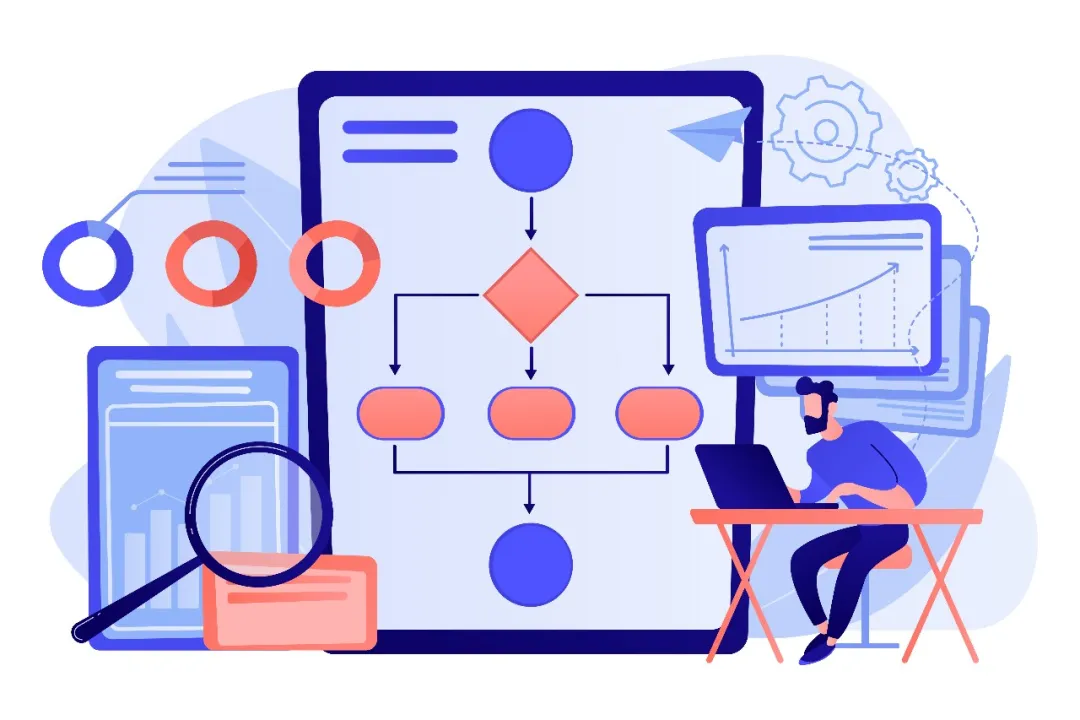
Q4. Is the inefficiency you’re seeing really slow execution, or is the organization itself slowing the work down?
AI is especially good at compressing execution time, which is also what makes it easy to get excited about. Work that took three hours to compile now takes ten minutes. Meeting notes that used to take forty minutes to write can now be generated within minutes of the meeting ending. That value is real and worth capturing.
But a large share of the time a company loses happens somewhere else entirely. A document takes five days to go from proposal to approval, yet the actual hands-on processing time might add up to less than an hour — the rest is waiting. A project goes through six rounds of revision, and the real problem may simply be that nobody nailed down who had final decision authority in round one. Employees compile similar-looking reports every day because different departments each insist on their own format, and no one has ever asked whether all of those reports still need to exist.
This is where task efficiency and organizational efficiency need to be pulled apart. Enterprise AI can make a single step extremely fast without changing the end-to-end business outcome at all. When companies evaluate enterprise AI projects purely by minutes saved per person, they tend to overstate the real value. A more useful approach is to trace a piece of work from the moment the need arises to the moment it’s delivered, and find out exactly where the time goes: execution, waiting, searching, confirming, rework, or decision-making. In many cases, technology should own part of that time, and the rest only changes if management practice changes alongside it.
Q5. Within a given task, what is execution — and what has always depended on human judgment?
Work used to be divided by job title — marketing does market analysis, sales owns the customer, customer service handles complaints, designers design. AI has made that division too coarse. Companies need to break a task down further and look closely at what each step actually involves.
In market research, for instance, AI can increasingly handle data gathering, organizing information, initial categorization and comparing sources. Recognizing that a particular piece of information is worth chasing further, working out why two data points contradict each other, judging whether a trend that looks significant actually matters to this specific company — that still depends on professional experience. Beyond that, deciding whether to change a product, commit budget, or shift market strategy based on that signal is already a business judgment.
This distinction shows up across most professional work. In the past, because a person handled every step, there was no need to spell it out this precisely. AI is forcing companies, for the first time, to seriously ask what actually creates value in a piece of work. Processing information is only part of it; judgment, experience, contextual understanding, risk trade-offs and accountability tend to sit deeper in the process than they first appear. The more capable the machine gets, the more precisely a company needs to know exactly where human judgment still needs to sit. It’s the same question we raised in “The Smarter AI Gets, the More Human Judgment Is Worth.”
Q6. When one step gets faster, does the whole process actually get better?
It’s easy for a company to produce an impressive single-point case study with enterprise AI: content output up fivefold in marketing, time spent compiling customer data cut in half for sales, product lookup time down from ten minutes to one for customer service. Those results are genuinely worth recognizing, but they don’t by themselves mean the company has captured a proportional gain in productivity. Work happens in a chain. When one upstream step suddenly speeds up and nothing downstream — processing capacity, review practices, decision rights — changes with it, a new bottleneck shows up almost immediately.
Marketing can generate dozens of content variations a day, but the brand lead still has to review them one by one. Sales can put together a quote in five minutes, but it still needs sign-off from three departments. Customer service gets an instant answer but still has no authority to handle the exception. When that happens, the time saved upstream tends to resurface downstream as waiting, rework, or added management burden.
We increasingly steer companies away from asking only “how much time did AI save this role” and toward asking “has the outcome actually improved, from the customer’s or the business’s point of view.” If the customer still waits five days, it’s genuinely valuable that one internal step went from three hours to thirty minutes — but that is not the same thing as the process itself getting five days shorter. For an enterprise AI project to move from individual efficiency to real value, it has to start looking at the whole chain.
Q7. Who is actually qualified to judge that AI’s output is ready to ship?
Generative AI has introduced a management problem that used to be rare: low-quality work can now come wrapped in a high degree of polish. The writing flows, the structure is complete, the charts look professional, the tone reads as competent — and a result that never received much real thought can look, on the surface, like a finished piece of work.
A study by Microsoft Research and Carnegie Mellon University, covering 319 knowledge workers and 936 real generative-AI use cases, found that the more users trusted generative AI, the less critical thinking they self-reported applying; conversely, people who were more confident in their own ability to complete the task were more likely to check, integrate and judge what the AI produced. The study also noted that generative AI hasn’t eliminated critical thinking so much as shifted it — cognitive effort now goes disproportionately into verification, integration and oversight.
That matches what we see in practice. AI makes it much easier for someone to hand over something that looks finished, but there is still a professional judgment call between finished and fit to deliver. If a company only trains people to generate output, without building verification standards alongside it, the cognitive cost hasn’t gone away — it has simply moved downstream to a manager, a colleague, or a customer.
Going forward, AI usage policy needs to go deeper than which tools are approved. What content must be fact-checked, what conclusions need a stated basis, which outputs require review by a qualified person, which decisions can be delegated to the system, and who is accountable when something goes wrong — these should gradually become part of the working standard. The more deeply AI gets used, the closer these rules come to corporate governance, and the further they move from being a tip in a training deck.
Q8. Are frontline employees being handed a new tool, or brought in to help design the new way of working?
Many enterprise AI projects still follow the old playbook for rolling out standard IT: leadership sets the direction, procurement or IT selects the tool, a vendor configures the system, training gets scheduled close to launch, and employees enter the process last. That sequence can work for standard software, but it runs into more trouble with human-AI collaboration, because what enterprise AI changes usually isn’t limited to operating steps — it extends to the boundaries of a job, how judgment gets exercised, and who is accountable for what.
Frontline employees hold a great deal of knowledge that the organization has never formally recorded: which customers are exceptions, when a policy can’t be applied mechanically, which document in the knowledge base looks current but hasn’t been true for a while, which seemingly redundant step is actually there to prevent a long-standing error. If that knowledge never enters the project during the design phase, the technical team ends up building a process that is logically sound and practically unworkable.
And involving employees doesn’t mean sending out a survey asking “what do you want AI to do for you.” More effective involvement means working with them to break down the real work, surface friction points, explain the exceptions, and pilot the new way of working on a small scale. Beyond reducing resistance, this is what actually improves the accuracy of how the problem gets defined and the solution gets designed. Employees aren’t simply the end users of an AI system — they are already part of how the company works.
Q9. Where is the company planning to reinvest the time AI frees up?
The question sounds simple, but most companies don’t actually have an answer. BCG’s 2026 AI at Work survey found that among frontline employees who use AI regularly, 42% save at least eight hours a week — the equivalent of a full working day — yet 66% have received no clear guidance on how that time should be redeployed.
That combination is worth sitting with. Companies are usually disciplined about managing scarce resources: an extra ten million in budget triggers a real debate about R&D versus marketing versus expansion; ten additional headcount prompts a decision about which department gets them. Enterprise AI is now freeing up a comparable amount of time, yet most companies still treat it purely as a matter of individual efficiency rather than as a resource-allocation question for the business.
A salesperson with eight extra hours a week could handle more accounts, or could redirect that time toward high-value clients, market feedback and relationship-building. A marketer who spends less time compiling materials could produce more content, or could go deeper into consumer research and strategy. A manager freed from routine reporting could fill the calendar with more meetings, or could reinvest that time in coaching the team and sharpening business judgment. Which choice a company makes leads to a very different kind of organizational capability down the line.
Left unmanaged, efficiency gains most naturally turn into more work. Employees quickly learn that openly reporting how much time they saved doesn’t necessarily work in their favor. AI ends up creating real, hidden capacity that the company never actually captures. Turning an efficiency dividend into organizational value has always been management’s job — AI hasn’t changed that.
Q10. Before the project started, did we define what result would actually justify further investment?
The easiest thing to measure in an enterprise AI project is adoption: how many accounts were opened, how many people use it weekly, how much content got generated, how many agents were built, how many steps got automated. Those numbers are good for showing how much activity a project has generated, but they say very little about the question a business owner actually cares about — whether the investment made the company better.
The right measures should trace back to Q1. If the original problem was long customer service wait times, track wait time, first-contact resolution and customer satisfaction. If sales couldn’t find the right materials, track search time, error rates, and how quickly new hires become productive. If the goal was better management decisions, track how long it takes to prepare information, the decision cycle, and the quality of the judgment made — not how many analysis reports AI generates each week.
These standards are best written down before the pilot begins. Doing so has a second benefit: when a project falls short of expectations, the team can actually discuss whether the problem lay in how the issue was defined, how the process was designed, technical capability, or organizational readiness — rather than defaulting to the easiest and least useful explanation, that the tool is fine and employees just don’t know how to use it.
The real value of a pilot was never to prove that AI works. Nobody in the market needs that proven anymore. What a company needs from a pilot is to know whether the change is worth building into standard process, whether the system should be given more authority, how roles and accountability should shift, and — before the next round of budget goes in — what the company is actually expecting to get for it.
In the Age of AI, We Need to Relearn How to Look at Work
Taken together, these ten questions may look like a conversation about AI, but what they’re really addressing is something much more fundamental to running a company: understanding the people doing the work, pinpointing where a problem actually occurs, telling symptoms apart from causes, breaking complex tasks into their real components, and judging change by actual outcomes rather than activity.
These are the same questions we’ve always worked through in Human-Centered Design. In product development, what a consumer says they want is only the starting point — the company still has to understand why they’d choose it. In brand work, a communication problem a client raises is sometimes just the surface; underneath it may be a gap in positioning, in the product portfolio, or in internal alignment. In improving the sales or employee experience, what looks like a “people problem” often turns out to be process, incentives and management rules underneath.
AI has changed the setting, not the underlying questions. How employees actually get work done, where judgment enters the process, which experience was never documented, which part of a process has long depended on people quietly working around it, what technology can genuinely change, and who remains accountable when something goes wrong — these questions used to be answerable, in a pinch, by relying on people’s experience to fill the gaps even when the company hadn’t fully thought them through. As more work shifts to models and systems, those gray areas stop being a workaround and start becoming a real source of risk.
This is exactly why we think Human-Centered Design matters more, not less, in the AI era. Technology keeps getting better at solving problems that have already been clearly defined. What companies now need to get better at is defining the problem in the first place. Direction has to come from leadership, because AI investment touches business objectives, resources, risk and organizational choices. But an accurate read of the real work has to come from the front line, because no management meeting can fully see the exceptions, workarounds and unspoken judgment calls that happen every day.
Strategy has to move top-down. Insight has to move bottom-up. The real design work of human-AI collaboration happens where those two directions actually meet.
The next stage of enterprise AI capability probably won’t be decided by who owns the most tools. Tools will keep getting cheaper, and model capability will keep becoming more widely available. What’s much harder to copy is whether a company can keep seeing its own work clearly, keep identifying the problems worth solving, keep recombining human experience with machine capability, and after every attempt, know what to keep and what to change. That is what it actually looks like for AI to move from an individual tool to an enterprise capability — and for enterprise AI adoption to genuinely take hold.
On the Next Stage of Human-AI
taasdesign is extending the Human-Centered Design and design thinking methods we’ve long applied to consumer insight, product and service innovation, and brand and organizational work into the design of human-AI collaboration and work itself in the AI era.
We’re currently opening up AI literacy and Human-AI experience sessions for company leadership teams — starting from business objectives and real, on-the-ground work, helping management build a shared understanding of what AI can and can’t do, identify which problems are worth prioritizing, and rethink how people, process, judgment and management practice need to adapt once technology enters daily work.
If your company has already started using AI, or is thinking through what the next stage should look like, we’d welcome the conversation.
* Images sourced from the internet.