
Services / 04
Human–AI Productivity System
We join your team, redesign how work is divided alongside your colleagues, and then put it into operation with technology vendors.
First we look at how one real process actually runs. Then we decide which steps stop, which go to machines, and which must stay with a named person who makes the call.

The Gap
Tools are rolled out, but output has not changed
Time saved does not turn itself into output. Someone has to decide what this role can now take on, whether this line can ship faster, and whether work that took three people now needs only two. In most companies nobody has made that decision, so the saved time is absorbed by routine tasks.
AI amplifies the way work is already done. A daily report may have been required after an incident years ago. The incident has long been forgotten, but the rule stayed. A colleague spent forty minutes a day compiling it. With AI it takes ten, and the format is tidier. What that report needed was to be stopped.
If the handoffs stay the same, individual speed only goes so far. Ten people may each work faster, yet work still passes from one to the next in the same sequence, under the same rules and with the same waits, so the cycle time of the whole line does not change. That waiting never shows up in a department’s report, since no department owns it.
Meanwhile, risk builds up. Employees use personal accounts to process company data and the company keeps no record. AI fills gaps with invented content that arrives complete in format and confident in tone. When something goes wrong, no one can tell who wrote a passage, whether AI was involved, or whether anyone checked it. All three problems share one root. No one has defined which work can go to machines, what must be prepared before handing it over, and who verifies it when it comes back.
Embedded
Embedded, on the client's side
A technology vendor cannot know which incident left that daily report behind, or that the three-day wait between two departments exists because one side’s performance metrics leave that step out. It cannot know that a technician with fifteen years on the line carries judgment nobody ever wrote down and the whole line depends on. Only the people who do the work know these things.
So we work inside the team and use human-centered design methods. We spend time next to people to see how they actually work, where they work around the system, what frustrates them, and which changes they can realistically accept. We play three roles within the client team.
01
Observe from the inside
We speak separately with leadership and frontline colleagues and map one complete process from start to finish, including who does each step, how long it takes, and how long work waits between steps.
02
Act as the client's representative
We turn our judgment into a technical requirements document and join the project on the client’s side, so the client does not have to face vendor claims alone.
03
Implement alongside technology vendors
Where a knowledge base, written output standards or scenario tuning is needed, we design them together with the client and the technology vendor.
Process
Four stages, then implementation
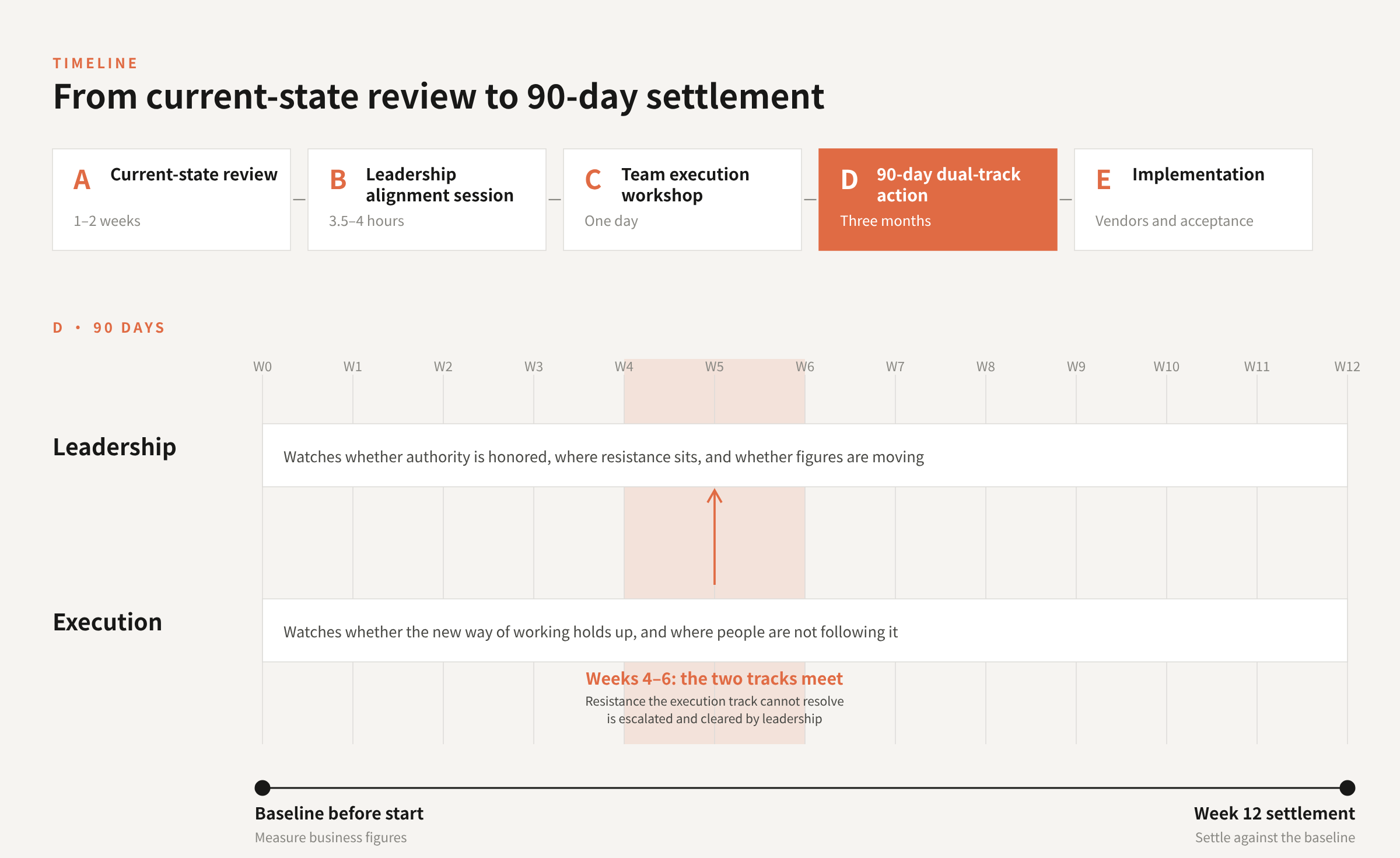
We lay one real business process out in the open and decide, step by step, who does what. Once the division of work is clear, a ninety-day action plan puts it into practice.
A
Current-state review
1–2 weeks
What we do
Interview the top executive, core leaders and key roles along the process, lay out one real process and measure the baseline
Output
Current-state process map, baseline figures, ranked candidate processes
B
Leadership alignment session
3.5–4 hours
What we do
The top executive and core leaders in one room to set direction, authority and the figures to move
Output
Agreed direction, decision rights, 90-day plan
C
Team execution workshop
One day
What we do
Colleagues from across the process reassign work between people and machines, step by step
Output
Redesigned process map, division-of-work table, technical requirements list
D
90-day dual-track action
Three months
What we do
Leadership and execution tracks run in parallel and settle against the baseline
Output
Change in business figures, repeatable practices
E
Implementation
What we do
Write the technical requirements document from the requirements list and work with the vendor as the client-side team
Output
Requirements document, acceptance records, post-launch review
Three Layers
Speed and efficiency come from three layers, and the order matters
1
Stop what shouldn't be done
This layer pays off immediately and needs no tools. When one process is mapped end to end, a few steps usually turn out to have had a reason once and have none now, such as an approval that expired long ago, a weekly report nobody opens, or the same data entered three times in three systems.
2
People who can actually use the tools
For a step marked “hand to a machine”, someone has to be able to actually hand it over. That means knowing how to break a real task into pieces a machine can handle, how to judge whether what comes back is right, and when not to trust it. People practice on their own real tasks rather than demo cases. General-purpose tools available today already cover most individual-level gains, so this layer usually needs no new purchase.
3
Tools that know the company
For AI to enter formal processes and produce stable output, general-purpose tools are not enough. They do not know the product lines, customer history or internal rules. Different people get different answers to the same question, and the tools do not carry the company’s standards for wording, format and compliance. This layer needs the company’s own knowledge base, written output standards, and tuning and validation for specific scenarios. Technology vendors build them, and we write the requirements precisely and verify acceptance.
The order has financial consequences. Allocate the work first and invest second, and you usually end up building far less than you first imagined. Many steps turn out not to need to exist once the process is mapped. What remains has a narrow scope and a clear goal, can be priced precisely, and gets used after launch. The reverse sequence starts with choosing tools, finding use cases and rolling out, then discovers that nobody uses them. The process has to bend around the tool, frontline colleagues find the work harder than before, and they find ways around it.
Deliverables
What you receive
All deliverables belong to the client and remain usable after the project ends.
Current-state process map and baseline figures
See how work really runs and where it waits, and set the starting point for settlement
Agreed direction, decision rights and 90-day plan
Decide which process moves first, who may remove steps, and which meeting receives reports
Redesigned process map and human–machine division-of-work table
For each step, whether it stops, goes to a machine, or stays with a named person who makes the call
AI usage policy and verification responsibility table
Which data may go to machines, who verifies what comes back, and what record is kept
Technical requirements list and requirements document
Ready for price comparison, vendor selection and acceptance
90-day settlement report
Change in business figures against the baseline, attribution analysis and recommendations for the next phase
Repeatable human–AI practices
Built into the company’s existing management meetings so the mechanism keeps running after the project ends
Difference
How this differs from other approaches
External diagnostic consultant
Typical delivery
A diagnosis and roadmap for several processes, with implementation arranged separately
Our approach
After the diagnosis we keep going: redesign the division of work, write the requirements document, take part in vendor selection and acceptance, and settle against the baseline at day ninety
Tool vendor
Typical delivery
The tool and its deployment
Our approach
Before any tool is chosen, we judge which steps do not need to exist, and review vendor proposals as the client’s representative
Training course
Typical delivery
Better individual skills
Our approach
Practice on real processes, delivering a redesigned process and a business figure that has moved
Fit
Who this is for, and what we need
Best suited to
- Organizations already using AI tools whose individual efficiency gains have not yet become company-level output.
- Organizations just starting with AI that want to clarify responsibilities and rules before introducing tools.
What we need from you
- The top executive and core leaders join the alignment session together. If only the top executive attends, no one carries it forward. If only the leaders attend, direction cannot be set.
- A real process to work on, and a co-owner on the client side.
- Frontline colleagues willing to describe how they actually work. Before each interview we explain how the conversation will be used.
Security & Scope
Data security and scope
Data security
Working inside a team means access to processes, data and unwritten internal rules. We sign a confidentiality agreement before work begins and agree the scope of data access with the client. How client data is used follows what both parties agree.
Scope
- We do not take on system development or operations. The technology vendor the client selects handles that.
- We do not promise specific productivity figures. Changes in business figures are calculated at day ninety against the baseline measured before work began.
- The project does not aim to reduce headcount and does not rank individual output.
FAQ
Frequently asked questions
Using AI means the foundation is in place, so you do not start from zero and will usually see results faster than a company with no experience. What this work does is connect individual efficiency to company-level output.
No. There are no habits to correct and no flood of output that looks complete but has not been judged. The first task is to remove work that does not need doing and to clarify responsibilities, which has nothing to do with whether AI is used. Doing this before introducing tools usually works better than the reverse.
It includes a learning component. On the day of the team workshop we teach how to hand real work to a machine and how to check what comes back. What we deliver is a redesigned process and a business figure that has moved.
The first two layers need no purchase. Stopping steps that should not be done and teaching people to use existing tools are the first results delivered within the ninety days. If the third layer needs a knowledge base or standards, we write the requirements as a list so the client can compare prices directly. The list has been tested against real work and its scope is usually smaller than first imagined.
The project aims to let the same people take on more business or shorten delivery cycles. It does not aim to reduce headcount and does not rank individual output.
For leadership, an interview of about 40 minutes, an alignment session of 3.5 to 4 hours, and three follow-ups within ninety days, one of which is held on the day of an existing management meeting. For the execution team, an interview of about 25 minutes, a one-day workshop, and four follow-ups within ninety days.
Some adjustments take effect on the day of the workshop, and steps that are no longer needed can be stopped before the session ends. Changes in business figures are calculated after week 12 against the figures before the project began.
Please see Data security and scope. A confidentiality agreement is signed before work begins and the scope of data access is agreed.
Start
Start with one real process
We begin with Stage A, the current-state review, which takes one to two weeks. The process map and baseline figures it produces belong to the client, and the client decides whether to continue to the later stages.
Book a 30-minute call to talk through your current situation.